Let’s walk through the story with calm, clear eyes what the children said, what the public saw, what the Church confirmed, and where the controversies began.
Three Children and an Ordinary Day That Changed Everything
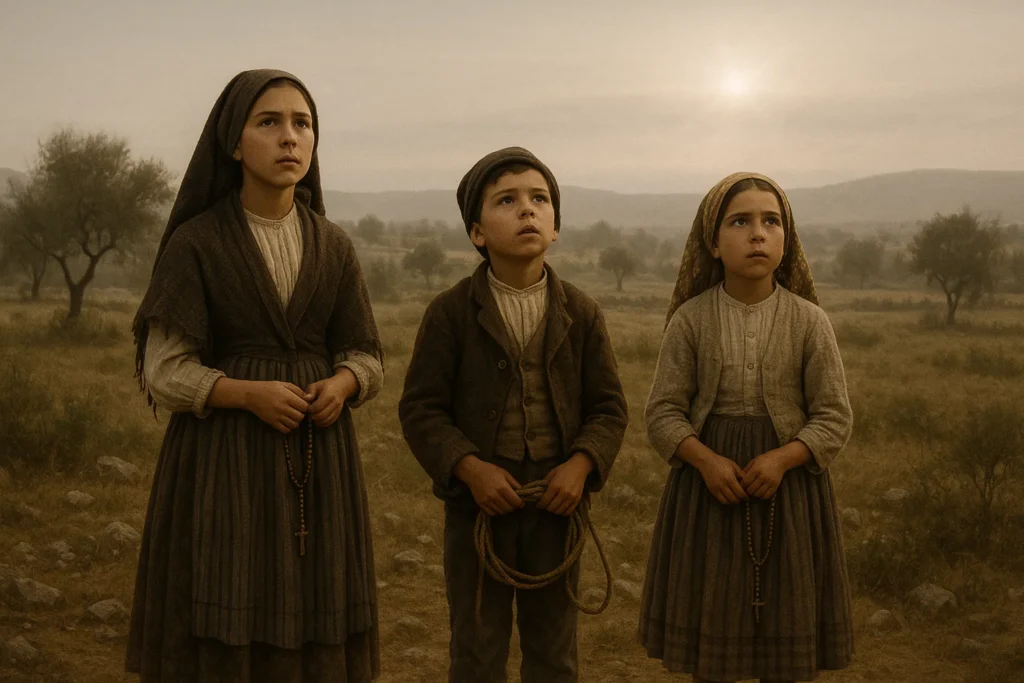
In the spring of 1917, life in Fatima was simple. The world beyond wasn’t. World War I was crushing Europe. People carried real fear on their shoulders every day. Against that backdrop, three shepherd children Lucia dos Santos, and her cousins Francisco and Jacinta Marto reported something unusual while tending their flock.
They said a radiant figure appeared above a small holm oak tree. They described her as peaceful, bright, and unlike any person they had ever seen. She became known as Our Lady of Fatima.
The children didn’t begin as messengers. They didn’t ask for attention. They were rural kids who suddenly found themselves pulled into a larger story.
What Happened During the Apparitions?
The children said the figure asked them to meet her on the 13th day of each month. According to them, she brought a consistent message:
- pray
- seek peace
- turn toward God
- prepare for difficult times
Not everyone believed them at first. But each month, more people followed the children to the field. Word spread across the region, then across Portugal. The gatherings went from a handful to thousands.
This wasn’t a private vision anymore. It had become a public event.
The Miracle of the Sun: What Thousands Said They Saw
By October 13, 1917, tens of thousands stood in the rain, waiting for something to happen. They came with doubts, hope, and curiosity. When the clouds broke, witnesses said the sun appeared to spin, pulse, and drop toward Earth before returning to its place. Clothes soaked by rain dried instantly. The crowd erupted in disbelief and awe.
Newspapers covered it. Skeptics tried to dismiss it as mass hysteria or an atmospheric illusion. Believers saw it as confirmation of everything the children had claimed. No matter the interpretation, one fact remains: the event was witnessed by an enormous crowd, making it one of the most documented mass sightings in modern history.
What the Church Investigated and Eventually Confirmed
The Catholic Church didn’t rush into approval. It opened a long inquiry, interviewing witnesses, reviewing the children’s statements, and weighing possible explanations. After years of examination, the Church declared the Fatima events “worthy of belief” and recognized the apparitions officially.
Lucia later became a nun and lived well into the 21st century, providing additional context and reflections on the events she experienced as a child.
So What Was the True Third Secret of Fatima?
This is where the story becomes complicated. The first two parts of the Fatima message were released earlier, dealing with visions of hell, war, and the need for prayer. The Third Secret stayed sealed for decades. That silence created more theories than answers.
When the Vatican finally released the text in 2000, it described a symbolic vision:
- a “bishop in white” walking through a ruined city
- violence
- suffering
- and a moment of martyrdom
The Church connected this vision to the 1981 assassination attempt on Pope John Paul II. Some accepted that explanation. Others argued the secret involved deeper spiritual warnings or predictions still unrevealed. The debate hasn’t settled, and the curiosity hasn’t faded.
Why Fatima’s Controversies Persist
Any event with this level of global attention ends up with layers of interpretation. Fatima is no different. The controversies focus on three key points:
1. The Third Secret
Some believe the Vatican held back part of the text. Others accept the published version.
2. Witness accounts
The sheer number of people who claimed to see the “Miracle of the Sun” keeps the discussion alive. Skeptics point to optical effects; believers point to the scale and timing.
3. Interpretation of the messages
Are they symbolic? Literal? Predictive? Meant only for that moment in history?
These questions keep Fatima in public conversation long after 1917.
What Actually Happened at Fatima?
Here’s the simplest way to put it:
- Three children reported six apparitions.
- The crowds around them grew rapidly.
- On the final day, thousands witnessed a dramatic celestial event.
- The Church investigated and approved the apparitions.
- The messages especially the Third Secret sparked decades of discussion, devotion, and controversy.
The story’s power isn’t just in whether every detail can be scientifically explained. It’s in how deeply these events shaped faith for millions across the world.
Why the Story Still Matters Today
Fatima isn’t just a chapter in religious history. It’s a reflection of human fear, hope, and the moments when the ordinary world feels pierced by something greater. People turn to the story when they’re searching for direction, when they’re worried about global unrest, or when they want to understand how faith moves communities.
You can believe in the miraculous aspects or stay grounded in historical skepticism, but the story’s influence remains undeniable.
Bottom line: Fatima endures because it feels bigger than its setting. A rural field became a meeting point between mystery and humanity, and that connection hasn’t loosened with time.

Jessica Savitch, with a deep passion for journalism, brings her expertise to istruestory.com as a dedicated author. MA in Arts & Journalism.