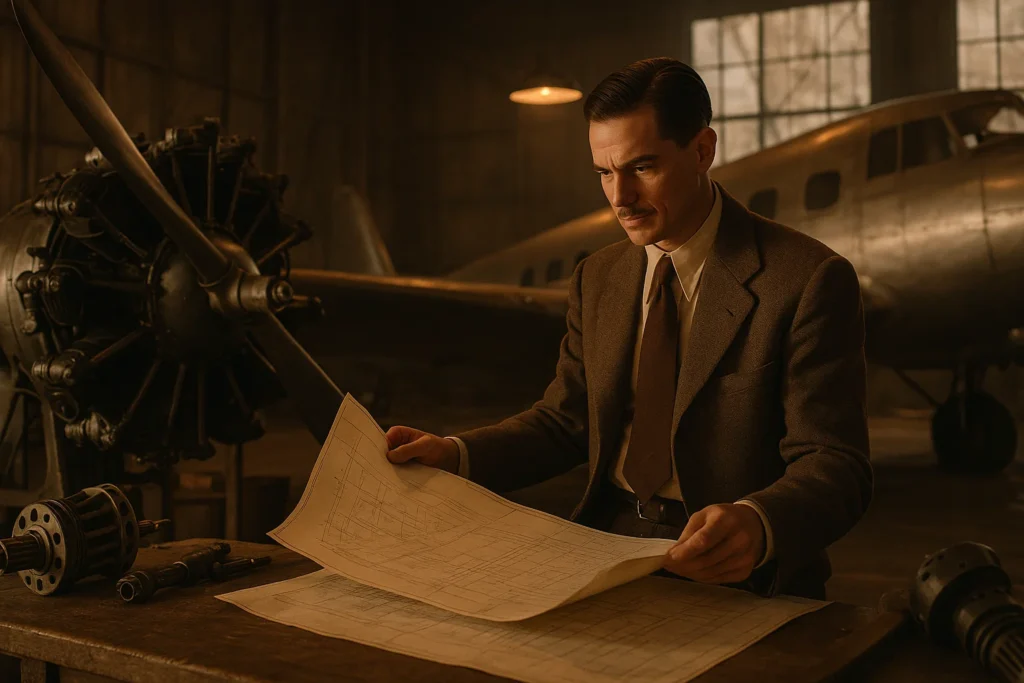
Before we sort the fact from the fiction, it helps to understand that Hughes wasn’t simply an aviator. He was a movie director, a business magnate, an inventor, and a man fighting invisible battles. The Aviator tries to capture all of that, and while it doesn’t tell every detail, it stays impressively close to the truth.
How True Was The Aviator?
Let me explain. Scorsese wasn’t trying to make a myth of Hughes; he wanted to show the man and the cost of his ambition. The film pulls from real events his record-setting flights, his high-profile romances, and his battles with both Hollywood and the government. According to sources like Collider and historical accounts, most major plot points match documented facts.
But films compress time, simplify relationships, and sharpen edges. In real life, some events were even more chaotic than the movie suggests. Others were less dramatic. Hughes’s aviation achievements, for example, were indeed extraordinary, but his day-to-day operations involved a level of relentless perfectionism that could never fit neatly into a two-hour runtime.
Bottom line: the movie gets the broad strokes right. It captures his world, his brilliance, and his breakdowns with surprising accuracy.
What Was the Controversy With Howard Hughes?
Hughes wasn’t a quiet genius. He made headlines for everything from government fights to financial missteps. One of the biggest controversies shown in the film involves his conflict with Senator Owen Brewster and the accusations of war profiteering an issue that did happen and left Hughes furious enough to testify publicly.
There was also the broader controversy of his business decisions. Hughes bought companies he could not fully control, invested in projects that spiraled financially, and clashed repeatedly with regulators. His rigid demands and unpredictable behavior only heightened the tension around him.
Hollywood wasn’t immune either. Directors and actors whispered about his endless retakes, extravagant budgets, and inability to compromise. But despite all that, people around him often described a man driven not by greed or vanity but by obsession. The controversies didn’t erase his achievements they simply revealed the cost of constant reinvention.
Did Howard Hughes Ever Marry?
Yes. The film mentions parts of Hughes’s romantic life, but it only scratches the surface. Hughes married twice:
- Ella Rice in 1925
- Jean Peters in 1957
His relationship with Peters lasted longer and carried more emotional depth than the film explores. They married quietly and lived even more privately. By then, Hughes had withdrawn significantly from public life, held back by anxiety, paranoia, and the physical pain resulting from years of aviation accidents.
Romances with figures like Katharine Hepburn and Ava Gardner were real as well, but Hughes’s personal relationships were often strained by his fears, absences, and relentless work. The movie captures the essence of those dynamics accurately, even when it condenses timelines.
The Film’s Most Important Question: What Mental Illness Did Howard Hughes Have?
This is where The Aviator becomes more intimate than most biopics. Hughes wasn’t simply a man under pressure he struggled with a severe form of obsessive-compulsive disorder (OCD). His fear of germs, repetitive behaviors, compulsive isolation, and fixation on cleanliness were documented long before they became central to the film’s portrayal.
His OCD existed before his aviation accidents, but those crashes made everything worse. Head injuries from multiple plane accidents intensified his anxiety, amplified his compulsions, and deepened his sense of fear. By the end of his life, Hughes’s world had shrunk to dim hotel rooms, stacks of boxes, and layers of rituals he couldn’t escape.
Scorsese and DiCaprio went to great lengths to portray his mental illness respectfully, pulling from letters, interviews, medical records, and eyewitness accounts. According to historical summaries, their portrayal aligns closely with what people who knew Hughes observed.
What the Movie Gets Right About Howard Hughes
Here’s what stands firmly on factual ground:
- His groundbreaking aviation records
Hughes truly pushed the limits of speed and altitude with unmatched ambition. - His obsession with detail
Whether it was rivets on the Hercules (Spruce Goose) or lighting in his films, he never settled for “good enough.” - His fear of germs and compulsive rituals
These weren’t invented for drama they were part of his everyday life. - His conflict with government officials
The hearings, accusations, and personal battles were all historically documented. - His turbulent Hollywood relationships
The tension, passion, and power struggles were very real.
The film succeeds because it doesn’t hide his flaws or sugarcoat his brilliance. It allows both to exist at once, the way they did in his life.
Where The Movie Takes Creative Liberties
No biopic escapes shaping the truth to fit the story. A few examples:
- Certain relationships are simplified.
- Some timelines are shortened or rearranged.
- A few conversations and scenes are dramatized because no record of them exists.
But none of these changes distort his character. They simply help the story breathe.
Why Howard Hughes Still Fascinates Us
Maybe it’s because he lived at the intersection of genius and fragility. Or because he chased innovation at a speed few could follow. Or maybe it’s because his life feels like a warning wrapped inside a legend: brilliance doesn’t protect anyone from the battles inside their own mind.
What The Aviator captures better than most biographical films is that both versions of Howard Hughes were real. The visionary. The tycoon. The recluse. The patient. The dreamer who never stopped pushing the limits of the sky.
In the End: So Is The Aviator a True Story?
Yes The Aviator is largely rooted in truth. It reflects documented events, historical accounts, and personal testimonies. It isn’t perfect, and it isn’t complete, but it stays faithful to the spirit of Hughes’s life.
It gives us a man who was larger than life yet painfully human.
A man who changed aviation but couldn’t escape his own mind.
A man who shaped an era yet died alone, trapped in rituals he couldn’t break.
That’s the story the movie tells and the story history remembers.

Jessica Savitch, with a deep passion for journalism, brings her expertise to istruestory.com as a dedicated author. MA in Arts & Journalism.