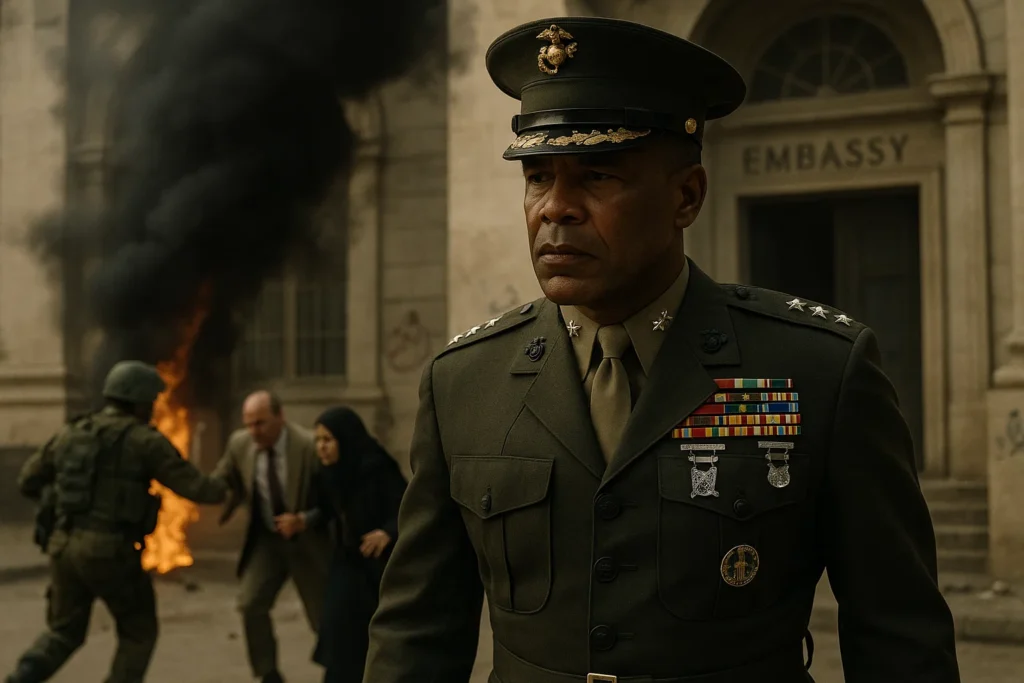
Was Colonel Terry Childers based on a real Marine?
Here’s what matters: the character looks and sounds like someone who could exist, but he isn’t pulled from any single real person. The film blends real-world military tensions with a fictional storyline, and that mix is where the confusion begins.
Let’s look at what’s real, what’s dramatized, and why this story has kept viewers debating for more than 20 years.
Why People Think Colonel Childers Is Real
The film opens with a rescue mission in Yemen that spirals into chaos. Protestors surround the U.S. Embassy, gunfire erupts, civilians fall, and Colonel Childers orders his Marines to fire back.
It’s intense. It’s messy. And it mirrors something people feel they’ve heard before.
Here’s the truth:
The U.S. has faced real embassy attacks. Real Marines have stood guard under pressure. Real civilians have been caught in crossfire. So even though the movie doesn’t tell a true story, it borrows the emotional weight of real events.
And that’s why the character hits so close to home. He feels like someone who might’ve existed, even though he didn’t.
Was Rules of Engagement a True Story?
Short answer: No.
Long answer: It’s fiction wrapped in a believable shell.
The screenplay was co-written by James Webb, a former Marine officer and Secretary of the Navy. He understood military culture from the inside the discipline, the ethics, the quiet anger that comes with impossible decisions. That experience shaped Childers into a character who feels lived-in.
But the events in the movie?
There’s no record, no case file, no Marine trial that matches Colonel Childers. The story was created for dramatic effect, not as a retelling of a classified operation.
What Happened to the Tape in the Movie?
This part always gets people talking.
In the film, a security tape shows who fired first during the embassy chaos. The tape could clear or condemn Colonel Childers. Instead, it disappears into the hands of political power players who decide what the public should and shouldn’t know.
This wasn’t based on a specific historical cover-up.
But it does mirror a familiar pattern in military and political dramas:
Information gets buried. Careers are protected. Someone becomes the sacrifice.
It’s storytelling designed to push every button about truth, accountability, and the painful gray zone where wars are often fought.
So What Was the Verdict in Rules of Engagement?
In court, Colonel Childers is accused of unnecessary slaughter. Prosecutors want to make him the face of American military aggression. Public opinion is already against him.
During the trial:
- Witness testimony is shaky
- The motives of political leaders twist the narrative
- The missing tape becomes the ghost in the room
In the end, Childers is acquitted of all major charges, though he receives a reprimand for ordering the ambassador to safety at gunpoint.
It’s not a clean victory.
It’s not total justice.
But it’s a verdict that reflects the film’s entire point:
No one walks away from an event like that untouched.
Tommy Lee Jones and the Marine Lawyer Angle
Another question that pops up:
What movie did Tommy Lee Jones play a Marine lawyer in?
This one’s easy: Rules of Engagement.
He plays Colonel Hays Hodges a weary, once-promising lawyer dragged back into the courtroom to defend his old friend, Terry Childers. Hodges isn’t portrayed as a perfect hero. He’s tired. He’s discouraged. But he knows Childers enough to understand what honor looks like, even in its most bruised form.
Their friendship carries the movie’s emotional weight. Two men who’ve seen war from the inside, standing shoulder to shoulder one last time.
So… Was There Ever a Real Colonel Terry Childers?
Here’s the bottom line:
There was no Marine colonel named Terry Childers who lived this story.
But the character was shaped by:
- Real military culture
- Real debates about rules of engagement
- Real moral conflicts Marines have faced
- Real political pressure behind battlefield decisions
So while the person isn’t real, the questions absolutely are.
The film pushed audiences to think about the impossible choices soldiers make in the fog of chaos, where there’s no time to debate ethics, and every order could save or destroy lives.
Why This Story Still Feels Real Today
You don’t need historical accuracy to feel the tension in Childers’ story. The movie drills into something more universal:
What does duty look like when every decision you make can be torn apart later by people who weren’t there?
That’s the heart of it.
And that’s why the “true story” question never goes away.
People aren’t really asking whether Colonel Childers existed.
They’re asking whether situations like his could happen.
And the honest answer is:
Yes some version of this conflict happens more often than most people want to believe.
Final Thoughts
Colonel Terry Childers may not have walked out of a real military base, worn real medals, or stood trial in a real courtroom. But the ethical storm he steps into is one many veterans recognize. It’s the kind of moral battleground where rules meet reality, and reality rarely plays fair.
That’s the power of Rules of Engagement.
It tells a fictional story that feels like it could’ve been true and sometimes, that’s what leaves the deepest mark.

Jessica Savitch, with a deep passion for journalism, brings her expertise to istruestory.com as a dedicated author. MA in Arts & Journalism.