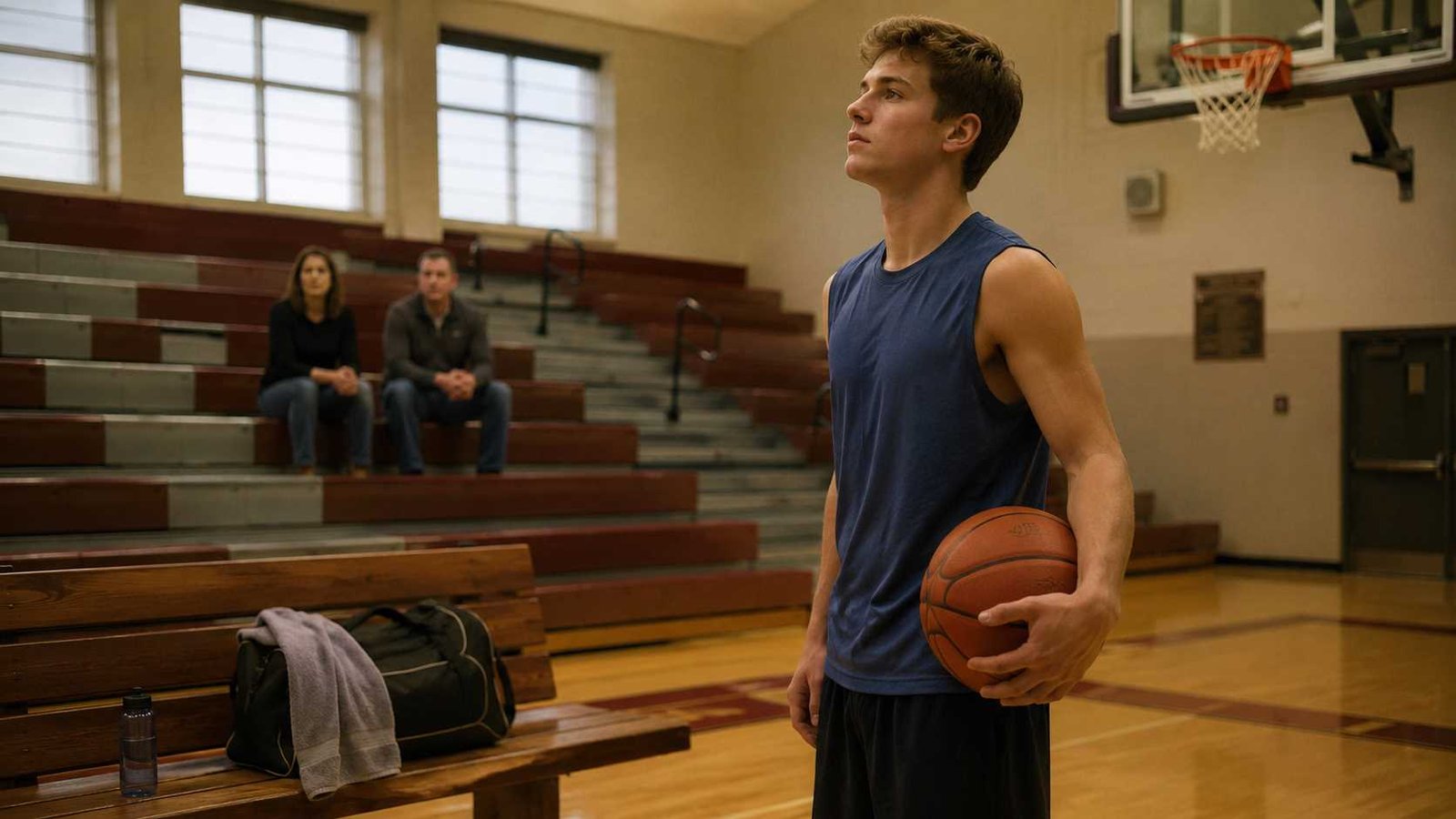
That is the frightening turn at the center of Hoovey. And unlike many sports dramas that simply borrow the words “inspired by true events,” the heart of this story really happened.
The Hoovey true story is based on the life of Eric “Hoovey” Elliott, an Illinois high school basketball player who developed a massive brain tumor, underwent major surgery, struggled through rehabilitation, and eventually returned to the game doctors feared he might never play again. The movie came from Rebounding from Death’s Door, the 2004 book written by Eric’s father, Jeff Elliott.
Perhaps the most surprising part comes after the movie’s emotional comeback. Eric did not simply step onto a basketball court again. He went on to earn a college basketball scholarship.
Is Hoovey Based on a True Story?
Yes. Hoovey is based on the real experiences of Eric “Hoovey” Elliott and his family.
The 2015 film, directed by Sean McNamara, stars Cody Linley as Eric, Patrick Warburton as his father Jeff, Lauren Holly as his mother Ruth, and Alyson Stoner as his sister Jen. The official film synopsis identifies it as a true story about a promising basketball player whose life changes after a brain tumor threatens both his health and his future in sports.
The story did not begin as a Hollywood screenplay.
Jeff Elliott first told his son’s experience in the book Rebounding from Death’s Door. Its description explains that Jeff was moved to write after watching Eric play his first college basketball game. Years earlier, Eric had been dealing with a serious brain tumor, double vision, and severe balance problems.
That detail changes the way you watch the film.
The basketball scenes are not simply there to give the movie an exciting ending. Basketball was part of Eric’s real life before his illness and became a measure of how far he had come afterward.
The Real Eric “Hoovey” Elliott
Eric grew up in Illinois and attended Olympia High School. Basketball was an important part of his teenage years, although accounts of his life also describe him as an athletic child involved in more than one sport.
Before doctors discovered the tumor, there were warning signs.
Jeff Elliott’s account describes blurred vision and unusual problems with coordination. Those symptoms were especially noticeable because Eric had normally been athletic and physically capable.
Eric later recalled that he had been suffering from headaches and sickness. He described the eventual discovery as a brain tumor roughly the size of an orange.
For a teenager focused on basketball, suddenly worrying about brain surgery instead of the next game is hard to imagine.
But survival came first.
His Brain Surgery Was Only the Beginning
Removing the tumor did not immediately restore Eric’s old life.
His father’s book describes the aftermath through problems that sound painfully basic: balance, eyesight, movement, and the ability to function normally. The book’s publisher summary says Eric overcame double vision and “zero balance” before eventually reaching college basketball.
Eric himself later explained that he had to learn how to walk and run without falling while dealing with double vision. He also said he was told he would not be able to play basketball again.
That may be the part of the Hoovey true story that the movie captures most effectively.
Recovery was not one dramatic moment.
It was repetition.
Standing.
Walking.
Trying to run.
Learning to trust his body again.
Then somehow trying to control a basketball when even ordinary movement had become difficult.
The official description of the film also reflects these real rehabilitation struggles, including Eric relearning how to walk, read, see clearly, dribble, and shoot.
Did Hoovey Play Basketball Again?
Yes. Eric “Hoovey” Elliott really did return to basketball.
And his comeback went considerably further than simply appearing in another high school game.
Eric eventually earned a college basketball scholarship. His father later publicly confirmed that after surviving the tumor and recovering, his son went on to win a basketball scholarship.
An account based on an interview with Eric provides even more detail. It reports that he overcame the effects of surgery well enough to earn a full basketball scholarship to Carl Sandburg College in Galesburg, Illinois, despite continuing problems with depth perception.
Jeff Elliott’s book description goes one step further: Eric also earned a starting position on his college team.
So when the movie builds toward Hoovey returning to the court, that basic victory is not a fictional feel-good ending.
The real Eric went further.
He became a college basketball player.
For someone once struggling simply to maintain his balance, that is a remarkable distance to travel.
The Elliott Family Was Fighting Another Battle Too
Hoovey is often described as a basketball movie, but the basketball comeback is only part of its story.
Eric’s illness affected his entire family.
Jeff Elliott has said that the medical crisis pushed the family close to bankruptcy. According to his account, he took additional work while Ruth also found ways to bring in money as they tried to meet their financial obligations.
That pressure appears in the film through Jeff and Ruth’s struggle to hold their household together while helping their son recover.
This part matters because serious illness rarely belongs to only one person.
Parents worry about treatment and money. Siblings can feel pushed to the side. Normal routines disappear. Plans that once seemed certain suddenly feel fragile.
The movie places Christian faith at the center of how the Elliott family responds to that uncertainty. Director Sean McNamara explained during production that the family’s Christianity was part of the real story and therefore an important part of the film.
Whether a viewer shares that faith or not, the family’s belief system helps explain the decisions, conversations, and emotional tone of Hoovey.
How Accurate Is the Hoovey Movie?
The safest answer is: the central story is real, but Hoovey is still a dramatized feature film rather than a documentary.
These core facts are well supported:
- Eric Elliott was a real Illinois high school basketball player.
- He suffered from a serious brain tumor.
- He underwent surgery.
- His recovery involved major problems with vision, balance, walking, and basketball.
- His family faced significant financial pressure.
- Faith was important to the Elliott family.
- Eric returned to basketball.
- He eventually received a college basketball scholarship.
At the same time, adaptations usually reshape conversations, timelines, supporting characters, and individual scenes so years of real life can fit inside a roughly 90-minute film.
One review comparing the movie with Jeff Elliott’s book specifically notes that there are differences and that the film takes creative license.
There is also one obvious change that viewers can verify without guessing: the real story took place in Illinois, while much of the movie was filmed in Texas.
So Hoovey should be understood as a dramatization built around a genuine medical and basketball comeback, not as a scene-by-scene historical record.
Who Did Hoovey Marry in Real Life?
Eric “Hoovey” Elliott married Laura Elliott.
A current biography from Paladin Sports Outreach identifies Laura as Eric’s wife. It also says they have two children, Caden and Chloe, and that the family moved from Illinois to Arizona in 2018.
There is a nice connection between Eric’s past and his later life too.
According to the same organization, Eric has remained involved with sports through coaching.
Basketball was once something doctors feared he might lose forever. Years later, sports remained part of the life he built with his own family.
That gives the movie’s comeback a different meaning. Getting back onto the court was not simply the end of Eric Elliott’s story. It was one stage in a much longer life.
Where Was Hoovey Filmed?
Although the Elliott family’s story is rooted in Illinois, Hoovey was filmed primarily in Texas, including Waxahachie and McKinney.
Waxahachie’s Convention and Visitors Bureau officially lists Hoovey among the movies shot there and even features a production photograph of cast members on location.
McKinney’s tourism authority also lists Hoovey in the city’s filmography, while IMDb’s production records identify locations in both Waxahachie and McKinney. Specific McKinney sites listed include the Heard-Craig House area and Finch Park.
That means the Midwestern-looking homes, streets, and basketball environments in the movie are not always the actual Illinois places where Eric grew up.
Texas was standing in for Illinois.
It is a good example of the difference between the movie’s visual world and the real geography behind the story.
Why Is Eric Called “Hoovey”?
Even Eric’s unusual nickname appears to come from real family history rather than a screenwriter trying to invent a memorable sports nickname.
An account of Jeff Elliott’s book explains that when Eric was very young, his forearm became caught in a Hoover vacuum cleaner. The incident supposedly led family members to call him “Hoover,” which eventually became “Hoovey.”
It is a small detail, but one that makes the story feel unusually personal.
Before there was a movie poster, a medical crisis, or a comeback story, “Hoovey” was simply a family nickname.
What Happened to Hoovey After the Events in the Movie?
The film naturally focuses on the dramatic part: illness, surgery, rehabilitation, and basketball.
Real life continued.
Eric progressed far enough athletically to play college basketball. The description of his father’s book says his recovery led not only to a scholarship but also to a starting position on his college team.
Later, Eric married Laura and became a father. The family eventually relocated from Illinois to Arizona, and Eric remained connected to youth sports through coaching.
There is something quietly satisfying about that part of the story.
Movies often end when the crowd cheers.
Real lives do not.
Eric still had adulthood ahead of him: marriage, children, work, family routines, and eventually helping younger athletes.
The basketball comeback was extraordinary. But perhaps the larger victory was simply getting the chance to have all those ordinary years afterward.
The Real Story Is Bigger Than the Final Score
It would be easy to describe Hoovey as another inspirational sports movie.
A teenager gets knocked down.
He fights back.
He returns to the court.
Crowd cheers. Credits roll.
But the Hoovey true story becomes more powerful when you know what happened beyond that familiar movie structure.
Eric Elliott really faced a massive brain tumor. He really struggled with balance and vision after surgery. His family really endured serious financial pressure. He really worked his way back toward basketball. And despite being told that playing again might not be possible, he eventually earned a college basketball scholarship.
Today, the story has another chapter. Eric is a husband and father, and sports continue to have a place in his family’s life.
That is what makes Hoovey more than a movie about one remarkable game.
The real victory was getting a life back.
And then continuing to live it.

Katie Couric, MA in Arts & Journalism. Crafting compelling narratives at istruestory.com. Passionate about bringing untold stories to light.