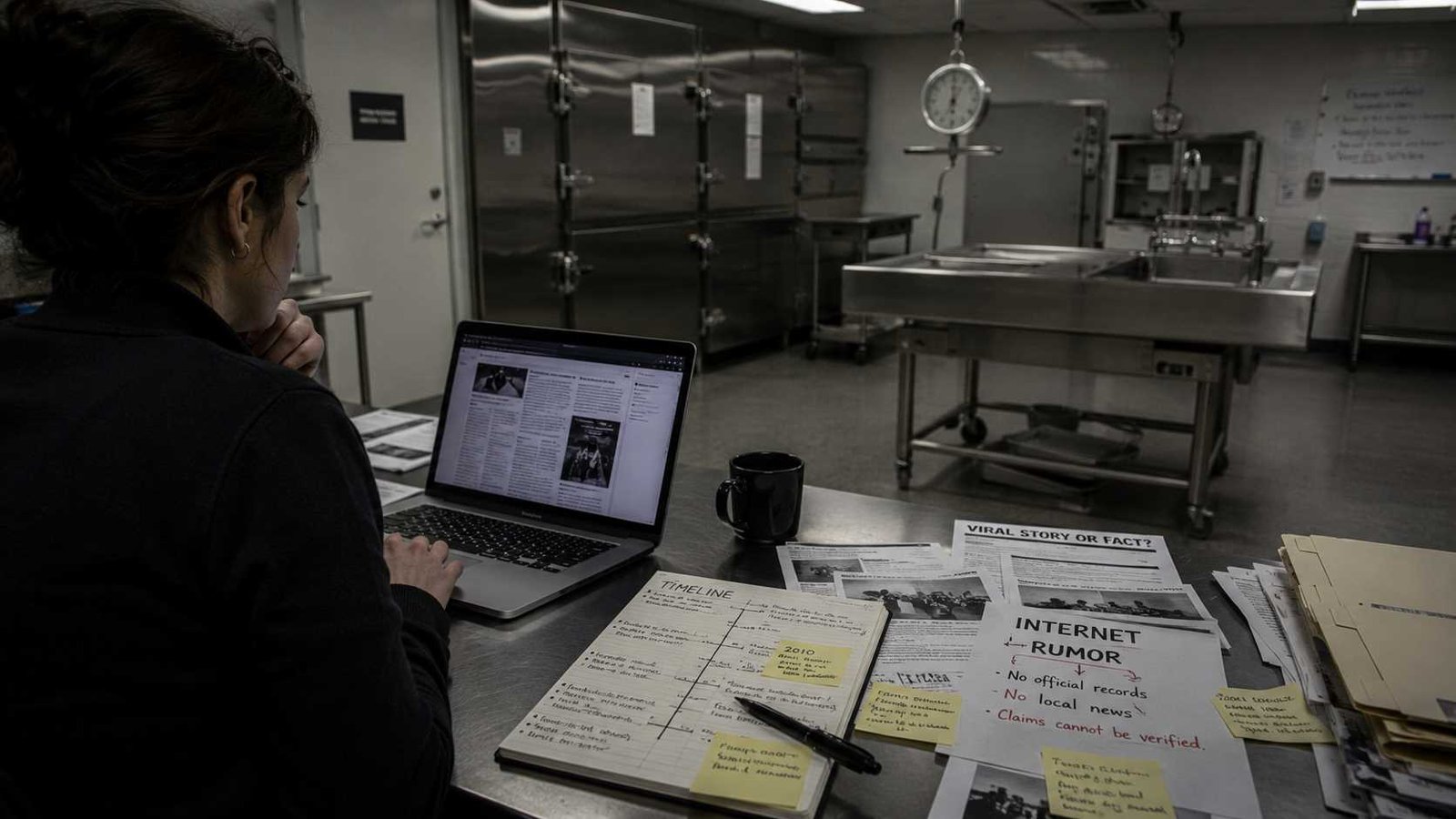
According to the story, a female mortuary worker in Missouri became pregnant after having sexual contact with the body of a dead man she was preparing for burial. She was supposedly arrested, and the shocking case later spread across blogs, forums, and social media.
There is just one major problem.
Felicity Marmaduke was not a real person at the center of a documented criminal case. The story began as satire.
That detail became lost as the tale traveled across the internet. Over time, Felicity’s name changed. Locations changed. Ages changed. Even parts of the alleged crime changed.
One later version introduced a woman named Jennifer Burrows, making an old fictional story look like breaking news all over again.
Here is where the story actually came from and why it continues to fool readers years later.
Was Felicity Marmaduke a real person?
There is no credible evidence that the Felicity Marmaduke described in the viral mortuary story existed.
The earliest version researchers have traced appeared in November 2010 on Dead Serious News. It described a woman named Felicity Marmaduke who supposedly worked at a mortuary near Lexington, Missouri.
But Dead Serious News openly identifies itself as a satirical website. More importantly, its About page says that, except for public figures, the names it uses are fictional.
That statement changes the entire meaning of the story.
It was not a hidden police report accidentally discovered online. It was not investigative journalism. It was written as fictional satire.
Fact-checkers later reached the same conclusion.
Africa Check traced versions of the claim circulating on social media and found that an earlier form of the story used the name Felicity Marmaduke. It identified Dead Serious News as the original satirical source and concluded that the alleged event did not happen.
So when someone asks whether the Felicity Marmaduke story is true, the short answer is no.
The more interesting question is how a satirical story survived for so long.
What did the original Felicity Marmaduke story claim?
The 2010 story presented itself in the familiar style of an outrageous local crime report.
It claimed that a 38-year-old mortuary employee named Felicity Marmaduke had been arrested near Lexington, Missouri, after becoming pregnant following sexual contact with a deceased male client.
Copies of the old article spread quickly through forums and other websites. Some preserved copies still show that the story was attributed to Dead Serious News in November 2010.
But when that text was copied away from the original site, something important often disappeared: the context telling readers that Dead Serious News was satire.
That is where a joke could start looking like a real crime report.
A reader might see a town name, an age, criminal charges, a mortuary and supposed police information. Those details create a feeling of credibility.
Yet believable details are not the same thing as evidence.
No reliable reporting has established that this Felicity Marmaduke case took place.
How Jennifer Burrows became part of the story
This is where the history gets even more revealing.
Years after the Felicity Marmaduke version appeared, a remarkably similar story began circulating under the name Jennifer Burrows.
In this version, Burrows was described as an assistant pathologist connected to medical examiner services in Missouri. The story claimed she had sexually abused numerous bodies and that DNA testing showed a deceased man was the father of her child.
Again, the story was false.
Lead Stories investigated the Jennifer Burrows claim in 2016 and found no legitimate evidence supporting it. The supposed case could not be found in Kansas City police information, and the source publishing the tale acknowledged the fictional nature of its content.
When the story resurfaced in 2018, Lead Stories debunked it again.
AFP conducted another investigation in 2019. It found that the Jennifer Burrows story came from a site describing its material as satirical and its characters as fictional. AFP concluded that there was no truth to the claim that a woman named Jennifer Burrows had been arrested for the acts described in the viral story.
Africa Check later traced the pattern even further back, noting that Felicity Marmaduke was the name used in the earlier 2010 version.
The names changed.
The shocking hook remained.
That is a classic sign of an internet legend being recycled rather than a real criminal case being reported.
Felicity Marmaduke and Jennifer Burrows are not two separate true cases
This point matters because search results can make the story appear larger than it really is.
You may encounter articles about Felicity Marmaduke and then find similar pages about Jennifer Burrows. At first glance, it can look as though two different mortuary workers were involved in nearly identical cases.
The evidence points in the opposite direction.
The Jennifer Burrows story appears to be a later variation of the same fictional concept.
A 2023 examination by TheNetline also traced the story from the Felicity Marmaduke version published in 2010 to the later Jennifer Burrows version.
That recycling explains why different versions disagree about basic details.
Names change.
Ages change.
Dates change.
The number of alleged victims changes.
Even the location can shift.
Real court cases normally leave behind a trail: police statements, arrest records, court documents and reporting by established local news organizations.
A viral story that repeatedly changes its central facts deserves much more skepticism.
Why did so many people believe it?
Part of the answer is emotional.
The story is designed to produce immediate shock. Most people do not regularly read about mortuary procedures or postmortem biology, so the claim also enters an area where readers may not have enough background knowledge to judge what is medically realistic.
Then there is the way internet stories travel.
Someone copies the original article.
Another site removes the satire label.
A social media account posts a screenshot.
Someone else adds photographs.
Eventually, people see the story without ever seeing the disclaimer attached to the original source.
Check Your Fact examined another resurfaced version in 2021 and found no evidence that the alleged event had taken place. It also noted the absence of credible reporting or police material supporting the story.
That is an important lesson.
A screenshot is not a source.
Neither is a repeated headline.
Ten websites repeating one unsupported story do not create ten independent pieces of evidence.
What about the photographs associated with the story?
Photographs can make a false claim feel much more convincing.
Some Jennifer Burrows posts circulated with what appeared to be mugshots of a woman. Readers naturally assumed they showed the person described in the story.
AFP performed a reverse-image investigation and found that photographs used with one version had previously appeared in unrelated Missouri news coverage involving a woman with a different name and an unrelated arrest.
In other words, attaching a real person’s photograph to a fictional story did not make the story real.
It only made the misinformation more persuasive.
Africa Check also noted that photographs circulated alongside versions of the claim, while finding no evidence that they established the alleged mortuary case.
This is one reason old internet hoaxes can become more believable with age. New publishers add images and details that were never part of reliable evidence.
Could pregnancy involving a deceased man’s sperm ever happen?
This is where an important distinction needs to be made.
The Felicity Marmaduke story is fictional. That does not mean every situation involving conception after a man’s death is medically impossible.
There is a recognized medical process known as postmortem sperm retrieval. In certain circumstances, sperm may be medically retrieved after a man’s death and later used through assisted reproductive procedures such as IVF.
AFP specifically discussed this distinction while debunking the Jennifer Burrows story.
That is completely different from the sensational scenario described in the viral Felicity Marmaduke tale.
One involves controlled medical procedures and reproductive medicine.
The other comes from a satirical internet story.
Mixing those two things together only makes the hoax more confusing.
Is Felicity Marmaduke connected to a “pregnant with a dead man’s child” novel?
Searches for pregnant with a dead man’s child novel can lead readers into a completely different group of stories.
There is no credible evidence that Felicity Marmaduke originated as a character in a novel. The evidence instead traces her to the 2010 Dead Serious News satire.
However, the phrase appears in unrelated works of fiction.
For example, Nadine Dorries’ novel Hide Her Name, part of the Four Streets series, involves a teenage character who is pregnant with the child of a man who has died. That is a fictional novel with its own characters and storyline and has no documented connection to Felicity Marmaduke.
The phrase also appears in descriptions of other books and stories, which may explain why search engines sometimes place novel-related results near searches about the viral mortuary tale.
The key distinction is simple:
Felicity Marmaduke came from online satire, not from a verified true event or a known novel adaptation.
How the hoax changed over time
The evolution of the story is more revealing than the story itself.
| Version | Name used | What the evidence shows |
|---|---|---|
| 2010 version | Felicity Marmaduke | Published by satirical Dead Serious News |
| Later recycled version | Jennifer Burrows | Published through fictional/satirical sources |
| Other variations | Different names and details | Reposts of the same basic false claim |
| Social media versions | Often unclear | Frequently separated from satire disclaimers |
Africa Check described the claim as an old satirical story repeatedly republished with changed details.
That explains why trying to reconcile every version is almost impossible.
There was never one reliable case file from which all the details came.
Writers were modifying fiction.
The biggest clue was there from the beginning
What makes the Felicity Marmaduke story fascinating is not whether the strange incident happened.
It is how easily fiction can become internet folklore.
Dead Serious News does not quietly hide its identity today. Its About page plainly calls the site satirical and says its non-public-figure names are fictional.
Yet once an article leaves its original website, readers may never see that explanation.
The headline survives.
The shocking details survive.
The disclaimer does not.
Years later, another site gives the fictional woman a new name. Someone adds a photograph. Social media delivers the story to an audience that has never heard of the original satire.
Suddenly, an old joke has a second life as a supposed true story.
So, what is the real Felicity Marmaduke story?
There is no verified Felicity Marmaduke true story matching the viral claim.
Felicity Marmaduke was a fictional name used in a satirical 2010 article about a mortuary worker. The tale spread beyond its original context and was eventually reworked into later versions, most famously the Jennifer Burrows story.
Multiple fact-checking organizations have found no credible evidence for the alleged crime.
The strange part is that the fiction never completely disappeared.
It simply changed names.
And perhaps that is the most useful thing to remember the next time an unbelievable true story appears on your screen: before asking how something so shocking could happen, first ask where the story came from.

Jessica Savitch, with a deep passion for journalism, brings her expertise to istruestory.com as a dedicated author. MA in Arts & Journalism.