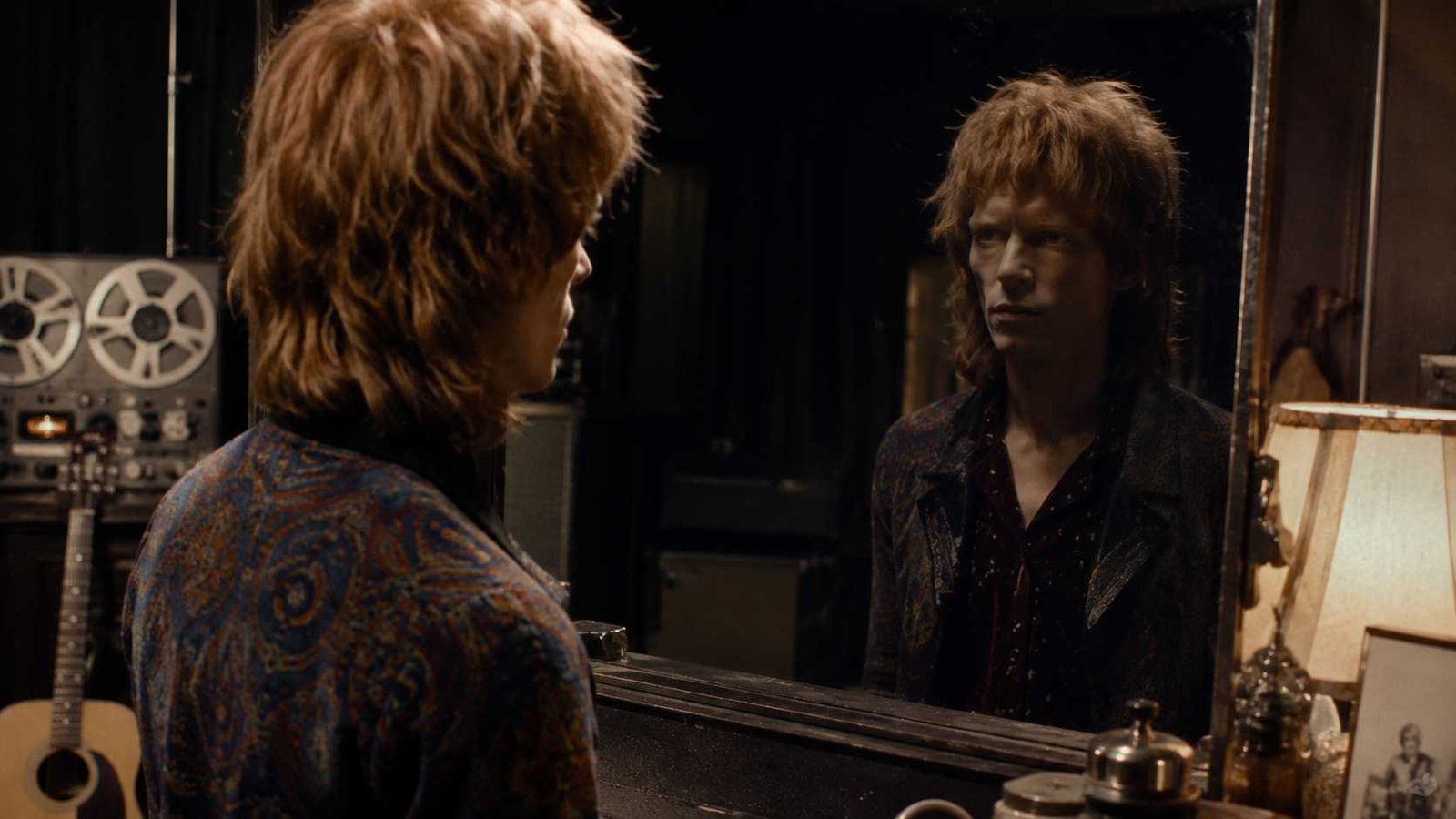
A man meets another man. They seem to know each other. One may even be another version of the other. Their conversation feels familiar, but also impossible. By the end, the listener is left wondering whether two people ever existed at all.
That mystery is the heart of The Man Who Sold The World meaning.
The song is best understood as a story about identity, self-discovery, isolation, and confronting a part of yourself you barely recognize. This is not just a fan theory. Years later, Bowie himself connected the song to his search for his own identity when he was young.
And then, more than two decades later, Kurt Cobain gave the song another life.
What Does The Man Who Sold the World Really Mean?
At its simplest, The Man Who Sold the World appears to describe a person meeting a mysterious version of himself.
The conversation feels like a meeting between two separate people. Yet the clues slowly suggest something stranger. The narrator and the mysterious man may represent two sides of the same identity.
That is why ideas such as a double, lost self, divided personality, and self-confrontation appear so often in discussions of the song.
The title can be misleading.
There is no clear story about someone literally selling the planet. Bowie does not explain a business deal, political conspiracy, or actual sale of the world.
Instead, “the man who sold the world” works more like a symbolic identity.
One possible reading is that the man has somehow given away part of himself. He may have sacrificed his private identity, lost control of who he was, or become disconnected from his real self.
That interpretation becomes especially interesting when we look at what Bowie later said about the song.
Bowie Gave Us an Important Clue Decades Later
In 1997, Bowie revisited The Man Who Sold the World during the ChangesNowBowie sessions.
The official David Bowie website confirms that the session was recorded in late 1996 and broadcast by the BBC around Bowie’s 50th birthday in January 1997.
During that period, Bowie explained that he had written the song partly because there was a part of himself he was still looking for.
He described the feeling of being young and knowing that some piece of your identity has not yet come together. He connected the song with the need to discover who you really are.
That explanation changes the way the song feels.
The strange man is no longer just a creepy stranger.
He can be understood as the person Bowie has not yet fully become, or perhaps a forgotten version of the person he once was.
Think about looking into a mirror and, for a moment, feeling disconnected from the face looking back.
You recognize it.
But somehow, it also feels like a stranger.
That emotional tension sits at the center of the song.
What Is the Story of The Man Who Sold the World?
There is a story in the song, but Bowie leaves most of it deliberately unexplained.
A narrator encounters a mysterious man. Their meeting appears to happen on a staircase. They speak as though they have some history together.
The narrator seems surprised because he believed this other person belonged to the distant past.
Then something unusual happens.
Instead of making the situation clearer, Bowie makes the identities of the two figures even harder to separate. What starts as an encounter between “I” and another person begins to sound more like an encounter between different versions of the same self.
The story can therefore be read on two levels.
On the surface, it is a strange meeting.
Underneath, it is a psychological confrontation.
The narrator may be meeting the person he used to be, the person he is becoming, or a side of himself he tried to bury.
Bowie never gives us a neat answer.
That is probably why the song has survived so well.
Did a Famous Poem Inspire the Song?
One literary connection is particularly hard to ignore.
Critics and Bowie reference works have linked the song with Antigonish, an 1899 poem by American poet William Hughes Mearns.
The poem describes an unsettling encounter with a man who appears not to exist. Its central idea is a person meeting someone who is somehow both there and not there.
That resembles the strange encounter in Bowie’s song.
Reference accounts of The Man Who Sold the World specifically identify Antigonish as an influence on its mysterious atmosphere and double-like character.
But there is an important distinction.
The Bowie song is not simply a musical version of Antigonish. Bowie takes the unsettling idea much further into questions about personal identity.
The poem gives us a mysterious stranger.
Bowie turns that stranger into someone who may be part of ourselves.
Why Did David Bowie Write The Man Who Sold the World?
The safest answer comes from Bowie himself.
He associated the song with searching for his identity.
When Bowie looked back on it in 1997, he described the uncertainty of youth, when a person can feel that an important part of themselves has not yet been discovered or understood.
That fits the period in which Bowie created the album.
Bowie’s official site dates The Man Who Sold the World album to November 1970 in the United States, followed by its UK release in April 1971. Tony Visconti produced the album.
Bowie had not yet fully transformed into the Ziggy Stardust figure who would make him an international star.
He was still experimenting with sound, image, identity, performance, and the boundary between David Bowie the person and David Bowie the public figure.
Seen from that angle, the song almost feels prophetic.
Bowie would spend much of his career creating and abandoning identities.
Ziggy Stardust.
Aladdin Sane.
The Thin White Duke.
Different looks, voices, characters, and musical worlds appeared and disappeared.
So a song about meeting another version of yourself fits surprisingly well into the larger Bowie story.
Does “Selling the World” Mean Selling Your Soul?
Possibly, but this should be treated as interpretation rather than fact.
Some listeners hear the title as a metaphor for sacrificing something personal in exchange for power, success, fame, or control.
That idea works especially well when applied to celebrity.
Imagine becoming famous enough that the public owns an image of you.
Millions of people know your face. They discuss your clothes, relationships, personality, and private life.
Yet that famous person may no longer feel exactly like you.
In that sense, someone could metaphorically “sell” his world by giving his private identity to the public.
It is a compelling interpretation of Bowie.
But Bowie’s own later explanation points more clearly toward self-searching and incomplete identity than toward a literal bargain involving fame or wealth.
The difference matters.
A good interpretation should deepen the song without pretending Bowie confirmed something he never did.
Then Kurt Cobain Walked Into the Story
For many younger listeners, The Man Who Sold the World did not first sound like a David Bowie song.
It sounded like Nirvana.
On November 18, 1993, Nirvana recorded its famous MTV Unplugged performance at Sony Music Studios in New York. Among the songs the band performed was Bowie’s The Man Who Sold the World.
Cobain did not choose the song randomly.
Bowie’s The Man Who Sold the World album appeared at No. 45 on Cobain’s handwritten list of 50 favorite albums.
That tells us something important.
Cobain was not simply searching for an unusual cover to fill the television set.
He genuinely admired the record.
Why Did Kurt Cobain Sing The Man Who Sold the World?
There is no detailed statement from Cobain explaining every emotional reason behind his choice.
So we should be careful about claiming that he sang it because the lyrics described his own life.
What we do know is stronger than speculation.
Cobain admired Bowie’s album enough to place it among his favorite records, and Nirvana deliberately included the title track in its MTV Unplugged set.
Nirvana also avoided turning the Unplugged show into a simple acoustic greatest-hits performance. The set included several covers and less obvious choices.
That made Bowie’s strange, haunting song a natural fit.
Cobain’s delivery then changed how many people heard it.
Bowie’s original feels eerie and detached.
Cobain’s version feels fragile and painfully close.
The words stayed Bowie’s.
The emotional temperature changed.
That is one of the strange powers of a great cover. A musician can inherit somebody else’s song and reveal an emotion inside it that listeners had never noticed before.
What Did David Bowie Think of Nirvana’s Version?
Bowie was impressed.
Accounts of his reaction report that he was surprised to discover how much Cobain admired his work. Bowie described Nirvana’s interpretation as straightforward and somehow very honest.
There was also an amusing consequence.
Nirvana’s performance became so famous that some younger fans apparently assumed Bowie was covering a Nirvana song when he later performed The Man Who Sold the World himself.
It is hard to imagine a better example of a cover version overtaking its source in popular memory.
Yet Cobain’s performance also sent countless listeners backward.
They discovered Nirvana.
Then they discovered Bowie.
Then they discovered an obscure, unsettling song written more than 20 years earlier.
Bowie and Cobain Made the Same Song Feel Different
The two versions tell us something fascinating about music.
With Bowie, the song feels like an intellectual mystery.
Who is this man?
Who is speaking?
Which identity is real?
With Cobain, those same questions can feel more emotionally exposed.
The listener may stop asking who the mysterious man literally is and start asking a more uncomfortable question:
What happens when you no longer recognize yourself?
That question works whether you are a rock star or an ordinary person.
Most people eventually meet an earlier version of themselves.
Maybe you find an old photograph.
Maybe you remember what you believed ten years ago.
Maybe you realize that the life you once wanted is completely different from the life you now have.
For a moment, the old you can feel like another person.
That is why Bowie’s strange encounter still feels human.
So, Who Is “The Man Who Sold the World”?
Bowie never hands us a name.
And perhaps he should not have.
The man can be Bowie.
He can be the narrator’s lost self.
He can represent a public personality separated from the private person underneath.
He can even be the version of ourselves that we leave behind while becoming someone new.
The most reliable clue remains Bowie’s own reflection that the song grew from searching for a part of himself and trying to understand who he really was.
That makes The Man Who Sold The World meaning less about selling something and more about losing, finding, and confronting identity.
More than half a century after Bowie recorded it, that question has not become old.
If anything, it has become easier to understand.
We all create versions of ourselves for other people.
The person at work.
The person with friends.
The person online.
The person our family remembers.
And somewhere underneath all of them is the uncomfortable question Bowie placed inside a mysterious rock song:
Which one is really me?

Jessica Savitch, with a deep passion for journalism, brings her expertise to istruestory.com as a dedicated author. MA in Arts & Journalism.