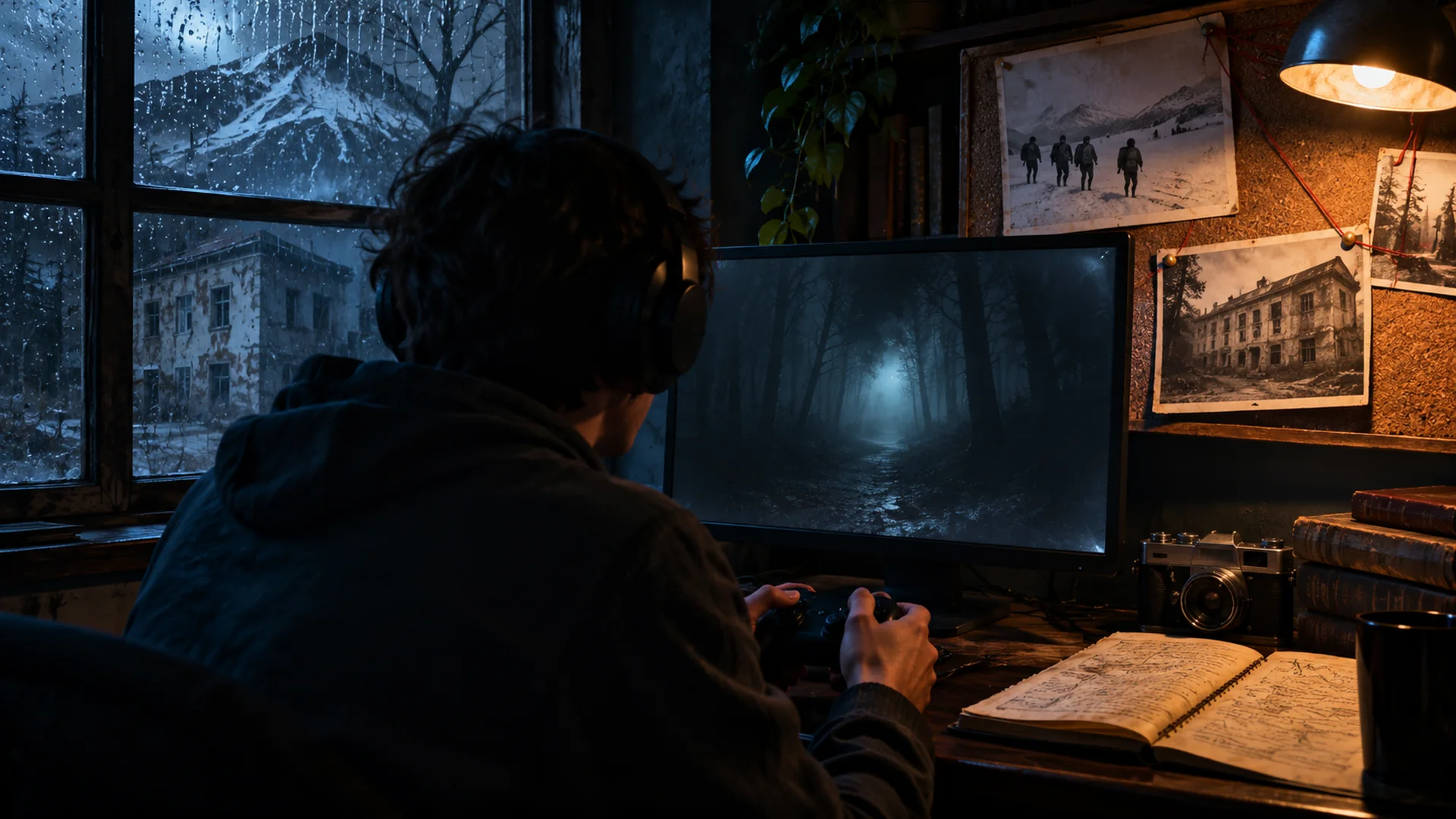
Some horror games are inspired by true stories, but very few recreate a documented event exactly. Kholat follows the mystery of nine hikers who died in the Ural Mountains. Detention draws its fear from a real period of political repression in Taiwan. Other games, including Fears to Fathom and İblis 3: Phenomena, make real-story claims that are harder to check.
That difference matters. A game can use real history, borrow from a person’s account, or simply place a fictional ghost in a believable setting. All three can be frightening. Only one gives us a well-documented historical event to investigate. Here are six games worth knowing, what evidence exists behind them, and where their stories leave the facts behind.
Are Horror Games Based on True Stories?
Yes, some are. But the phrase based on true events can mean several things. A developer may build a story around an actual tragedy, choose an authentic place or era, adapt an anonymous account, or make a claim about an event that has no independently available evidence. The level of proof is not the same.
For this comparison, documented history means an event or setting supported by independent records or credible research. Reported experience means someone says something happened, but the public cannot confirm each detail. Legend or fiction describes frightening ideas that should not be presented as established history.
The most important question is not whether a game displays a true-story label. It is which part of the story can be checked without relying only on the game’s own advertising.
Six Horror Games Inspired by Real Events
1. Kholat — The 1959 Dyatlov Pass Tragedy
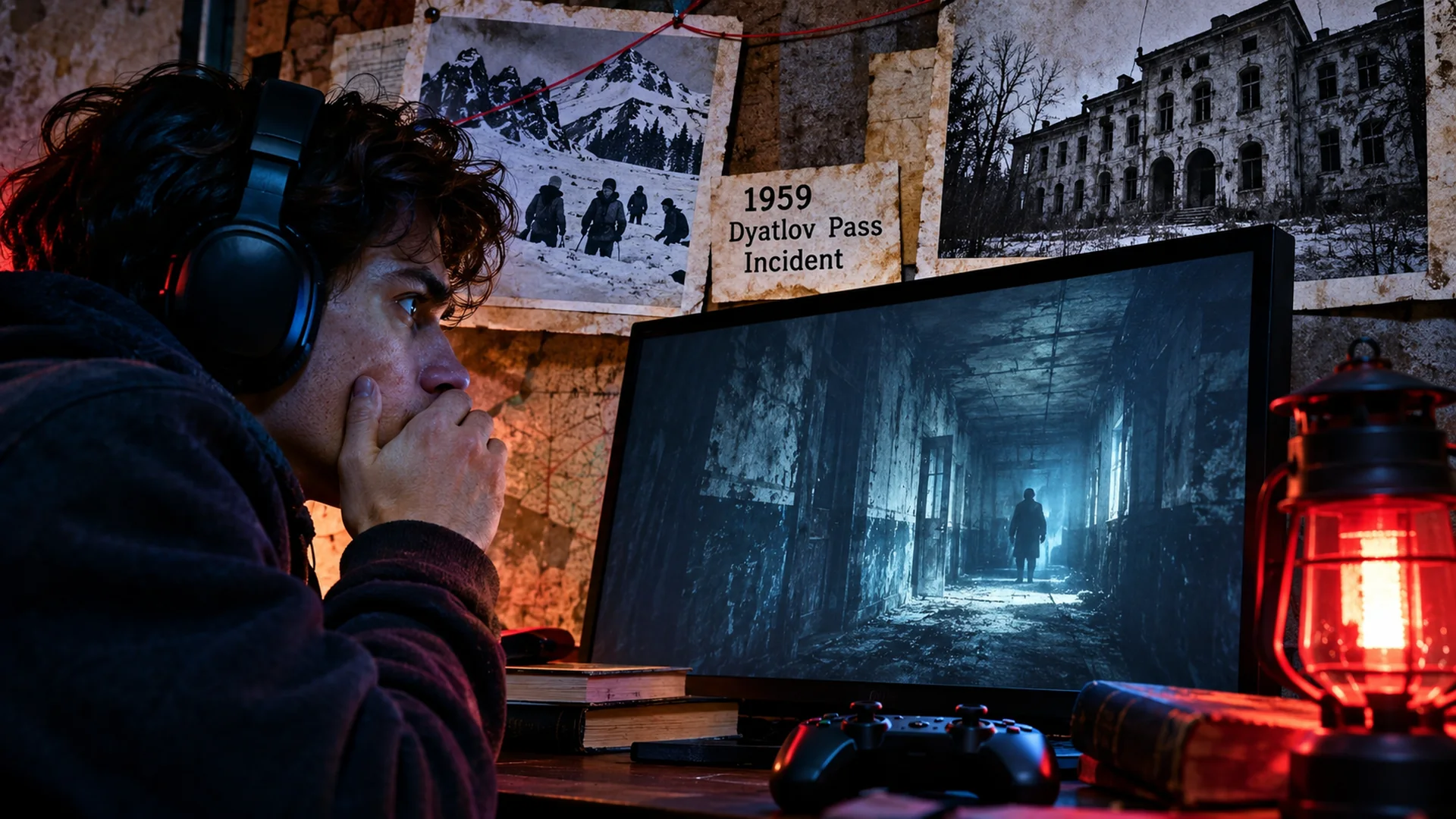
In February 1959, nine experienced hikers died during a winter expedition in the northern Ural Mountains of the Soviet Union. Their deaths became known as the Dyatlov Pass incident. The circumstances were disturbing, and the case attracted theories ranging from extreme weather to secret experiments and supernatural forces. The victims were real people, not characters invented for a game.
Released in 2015, Kholat sends players into a bleak mountain landscape to explore this mystery. Its official game description openly calls the story a fictional adventure inspired by the incident. The mountain setting and the hikers’ deaths are historical; the threatening presences and the player’s journey are entertainment, not a reconstruction of confirmed events.
Research has also changed how the tragedy is understood. A 2021 scientific study modeled how a slab avalanche could have occurred near the tent. A 2022 follow-up reported observations supporting the area’s avalanche risk. That explanation is scientifically plausible, although it does not turn every detail of the night into a certainty.
Verdict: A real disaster inspired the game; its supernatural plot and exploration are fictional.
2. The Town of Light — A Real Italian Psychiatric Hospital
Horror does not need a monster. The Town of Light explores a much more human fear: being powerless inside an institution. Its setting is the former psychiatric hospital at Volterra, in Tuscany, Italy, which was an actual institution. The game follows Renée, a young woman trying to understand her past.
Publisher Wired Productions describes the game as inspired by true accounts and real events. The historical environment gives the story its weight, especially its portrayal of patient vulnerability and harsh institutional practices. But Renée’s specific journey is a written character story, not a verified biography of a named former patient.
That makes the distinction between setting and plot crucial. A real building can be the foundation for a fictional story without proving that every scene happened. Readers interested in how real psychiatric buildings become horror settings can compare the topic with the separate Gonjiam Haunted Asylum true-story investigation.
Verdict: Real institution and historical context; fictional central character and dramatized events.
3. Detention — Taiwan’s White Terror Period
The fear in Detention grows out of a specific political setting. Developed by Taiwanese studio Red Candle Games and released in 2017, it takes place in a haunted school in 1960s Taiwan, when the island was under martial law. The supernatural imagery works alongside anxiety about punishment, secrecy and the loss of personal freedom.
In its official press kit, Red Candle says the game is based on the setting of Taiwan under martial law and draws on local religious and cultural traditions. That does not make its school haunting a documented real incident. Its characters and ghost story communicate the emotional weight of history through fiction.
This is one of the clearest examples of a game that is historically grounded without being a literal retelling of one individual’s case. The period and political pressures were real. The game’s particular chain of supernatural events is invented.
Verdict: Authentic historical backdrop; fictional characters and haunting.
4. The Devil in Me — The Crimes of H. H. Holmes
The killer behind the inspiration for The Devil in Me was real. H. H. Holmes, who operated in late-19th-century America, was convicted of murder and became notorious for stories about a supposedly deadly Chicago building. The game turns that reputation into a modern trap-filled hotel where a documentary crew fights to survive.
The game developer’s summary describes a present-day group invited to a replica of Holmes’s so-called Murder Hotel. Game director Tom Heaton also discussed Holmes as an inspiration in a PlayStation developer feature. The invitation, the crew and the deadly situations belong to the game’s invented plot.
There is an important historical warning here. Tales of 200 victims and an elaborate hotel full of traps were enlarged by sensational reporting. Historians interviewed by HISTORY and discussed by Smithsonian Magazine have questioned major parts of that familiar Murder Castle legend. The real crimes were serious enough without treating every old newspaper claim as fact.
Verdict: A real criminal inspired the design; the modern story is fictional, and even some famous historical details are disputed.
5. Fears to Fathom — Survivor Stories or Fiction?
Fears to Fathom often feels more possible than a supernatural game. Its threats include isolation, strange visitors and ordinary places that suddenly seem unsafe. Developer Rayll Studios describes the episodic series as short stories narrated by survivors. This is a claim about the series’ storytelling approach, not public proof that each named episode occurred exactly as shown.
A crucial distinction is that anonymous submissions cannot automatically be matched to police reports or identified survivors. A 2026 Destructoid investigation also questioned whether the episodes should be treated as documented true cases. Realistic situations do exist; those similarities do not establish the particular plots as historical fact.
For a closer look at the fire-watchtower episode and its claims, see our Fears to Fathom: Ironbark Lookout true-story guide. The safest verdict is that the franchise is marketed around survivor accounts, while public verification of individual stories remains limited.
Verdict: Survivor-story framing, but specific incidents are not independently established.
6. İblis 3: Phenomena — Is the 1994 Turkish Story Real?
The Steam description of İblis 3: Phenomena says it was inspired by an event in eastern Turkey in 1994. Its plot concerns Suna, a young woman pushed toward marriage who visits her dead mother’s grave. The game develops this into a disturbing story involving a wedding and apparent paranormal events.
That official description also says names and locations were changed and suggests searching for reports of a cemetery incident. Those are statements made by the developer. They do not, by themselves, identify an independent archive, official report or named witness that confirms the full incident. We could not independently establish the alleged paranormal events from the public material reviewed.
Forced marriage is a serious real-world issue, but it should not be used as proof of the game’s supernatural plot. Treat the 1994 connection as a developer claim, not a verified ghost story. That leaves room to appreciate the game without mistaking its warning message or atmosphere for evidence.
Verdict: Claimed inspiration from a 1994 event; the specific incident and supernatural details are unverified.
Horror Games Inspired by Legends Rather Than Proven Events
Not every famous horror setting has a matching real disaster. Many games combine local folklore, abandoned places, nightmares and familiar fears to create something new. A haunted school or empty town may feel historically specific while its creatures, deaths and supernatural rules remain fictional.
Silent Hill shows why checking each claim matters. Online discussions often connect the franchise to real abandoned towns or the Pennsylvania mine fire at Centralia. That is not proof that the original games retell Centralia’s history. Different titles, film adaptations and fan theories have their own creative backgrounds. Our Silent Hill real-story explainer examines the claims readers encounter.
The same caution applies to ghost stories passed from person to person. A place can exist, a witness can sincerely believe an experience happened, and the supernatural explanation can still be unproven.
Real Events vs Fiction: What Actually Happened?
A quick comparison makes the levels of evidence easier to see. Here, “documented” refers to the underlying history, not the entire game plot.
| Game | Real-world basis | Evidence verdict |
|---|---|---|
| Kholat | Nine hikers died in 1959 | Documented event; fictional game story |
| The Town of Light | Volterra psychiatric hospital | Real setting; dramatized character |
| Detention | 1960s martial-law Taiwan | Documented era; fictional haunting |
| The Devil in Me | H. H. Holmes and his crimes | Real killer; exaggerated lore and fictional plot |
| Fears to Fathom | Stories presented as survivor accounts | Specific episodes not independently confirmed |
| İblis 3: Phenomena | Claimed Turkish incident in 1994 | Developer claim; incident unverified |
These are not scores for how frightening the games are. They show the kind of evidence available for the connection to reality. The strongest historical links belong to Kholat, The Town of Light and Detention, although none should be mistaken for a documentary.
What Happens at 3 AM? The Scary Myth Explained
Stories about the “witching hour” often treat 3 AM as a dangerous time when ghosts or demons become active. That idea belongs to folklore and horror storytelling. There is no reliable scientific evidence that supernatural activity begins at a fixed hour. A clock showing 3:00 does not make a room haunted.
There is, however, an ordinary reason that hour can feel unsettling. People may wake during lighter stages of sleep, especially after stress, light exposure or other disturbances. Cleveland Clinic sleep guidance explains several reasons for waking around 3 AM, including sleep cycles, noise, anxiety and physical discomfort. Fear can feel stronger when it is dark and quiet, especially after an intense game.
If you like comparing folklore with alleged personal experiences, our collection of scary ghost stories offers more tales to examine critically. A good scary tale does not need to be scientifically proven to work as entertainment.
What Is the No. 1 Horror Game?
There is no single official number-one horror game for every player. Some people fear psychological suspense; others react most strongly to chases, loud jump scares or bleak atmosphere. Ratings can also change as new games appear.
One measurable answer comes from the 2026 Science of Scare video-game study. It ranked MADiSON first among the tested, purchasable titles, giving it a Game Scare Score of 91 out of 100 based on heart-rate reactions. Amnesia: The Bunker followed with 89. The study is a defined experiment involving a selected group of games and players, not a universal verdict on quality or a claim that MADiSON is a true story.
For the most frightening game with a well-documented event behind it, Kholat offers a more direct answer to this article’s topic. For historically grounded psychological horror, Detention is a strong alternative.
Which True-Story Horror Game Should You Play?
Choose according to the kind of real-world connection you want. These suggestions are about the story and setting, not a claim that one title is objectively better than another.
- For a real unexplained tragedy: Try Kholat, then read about modern avalanche research to separate the case from its inventions.
- For a serious historical setting: Choose Detention for political history woven into supernatural storytelling.
- For human, non-monster horror: Consider The Town of Light, which handles difficult institutional themes and deserves a thoughtful approach.
- For true-crime inspiration: Pick The Devil in Me, but keep the exaggerated Holmes legends in mind.
- For everyday survival suspense: Try Fears to Fathom while treating its survivor framing as unverified.
- For Turkish supernatural folklore: Explore İblis 3 as claimed inspiration, not confirmed paranormal history.
The unsettling truth is often simpler than the marketing. The hikers at Dyatlov Pass really died. Taiwan’s martial-law years were real. Volterra’s institution existed. A developer can add ghosts, jump scares and dramatic choices around those facts, but the real people and events deserve to remain distinct from the fiction. That is what makes horror games based on true stories worth investigating, long after the screen goes dark.

I am Jeremy Jahns – Your Cinematic Explorer
Immerse in movie reviews, Hollywood insights, and behind-the-scenes stories.